Lightspeed's new office is located in the canal belt, in a part of the canal belt that has its origin in the early 15th century. Since then, parts of the building of it have been demolished, expanded, mutilated and renovated, resulting in a fascinated multilayered building. At the start of the project, the biggest social democratic Dutch political party had just moved out after decennia.
Roughly, the building consisted of three parts. The classical and more or less original facade front part that consisted of many small rooms placed in a symmetrical order. Many of the walls had been knocked out to create bigger spaces.
The end part in the back of the garden was a former cotton factory and was added around 1930. It consisted of one big open one-layer space over the full width of the plot, lined with shed roofs.
The middle part was added in 1960 and consisted of two big spaces stacked onto each other. This part was the least characteristic, and also of questionable quality, since it contained dark spaces with relatively low ceilings.
To fit the program, the qualities of the three spaces were exaggerated:
In the first part, we restored the original room layout to create spaces for different departments, like legal, accounting, HR, etc. The original room sizes turned out to be a perfect fit for team working. All the new walls were designed in another material to clearly mark the difference between history and new addition.
The former factory space became a large flexible space that can accommodate parties, lunch spaces, big events and brother activities with up to 200 people.
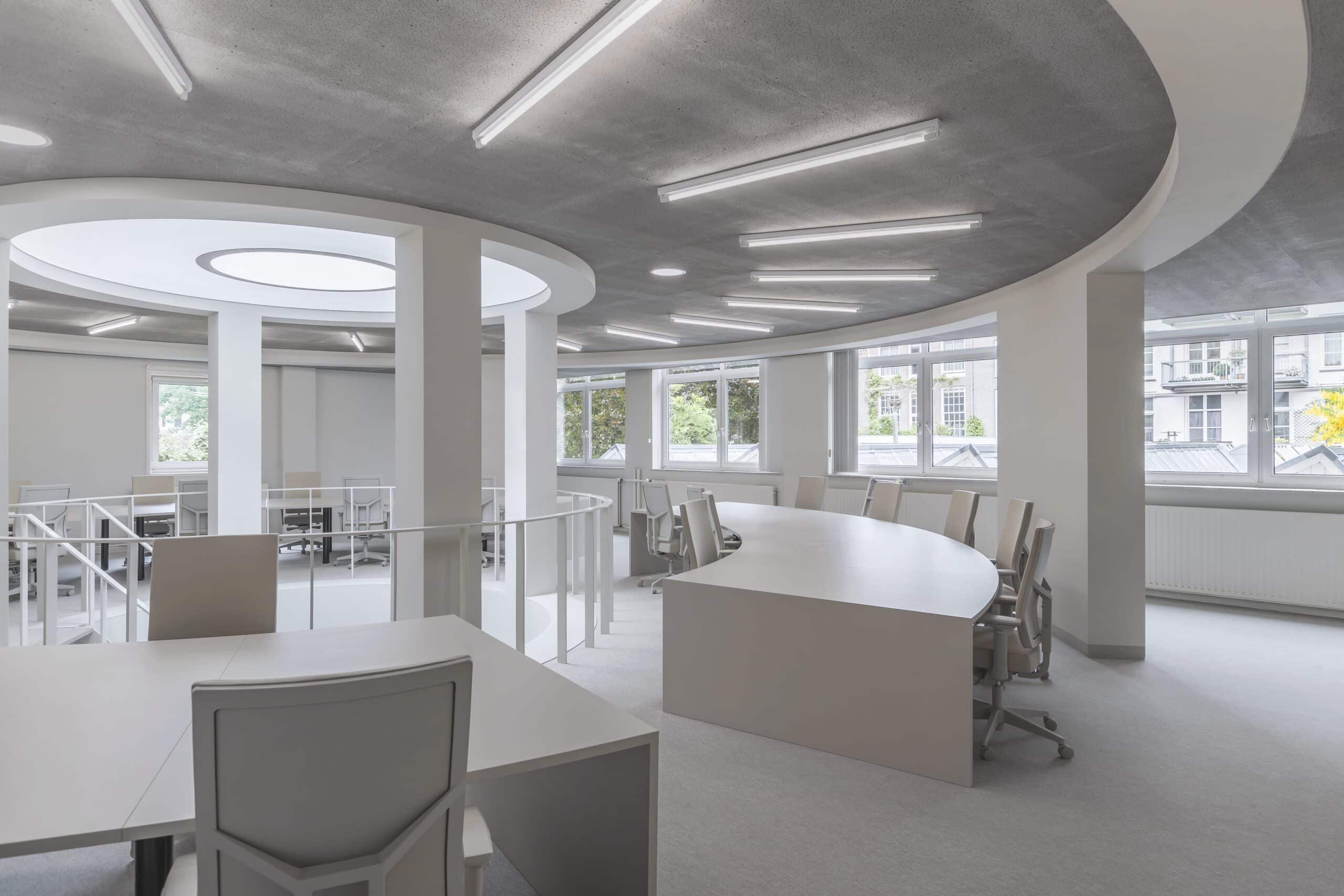
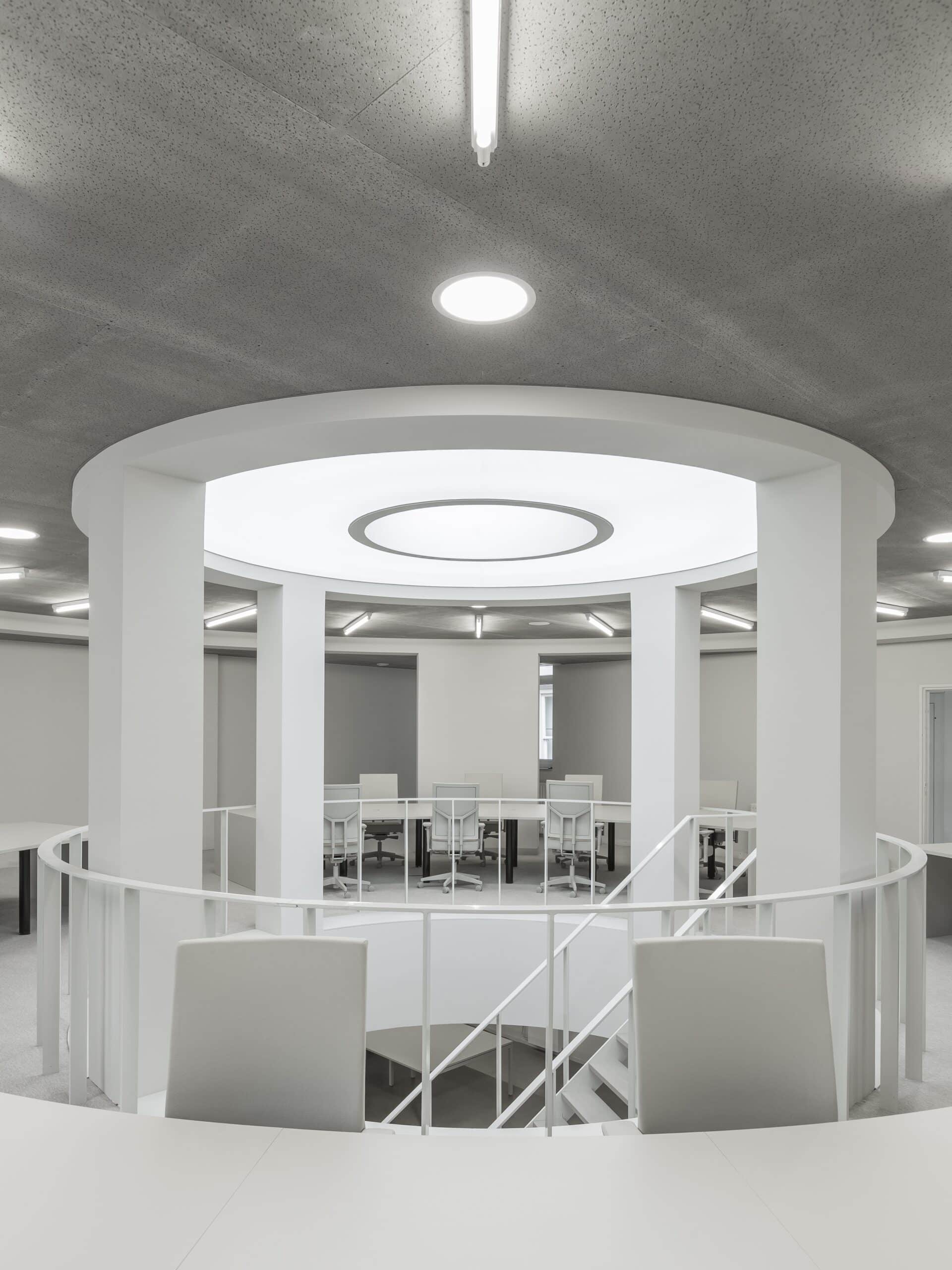
In the middle part Lightspeed's biggest (and loudest) departments are located: sales, marketing and support. The departments asked for a competitive environment so we created an arena-type space where they went to war. In the original building from around 1650, this space was a round conservatory, hence the round shape. This shape enables people to see each other, which helps improve the competitiveness.
To improve the quality of the space we created a roof light and a hole in the floor, so natural light reaches deeper into the building. The original 1650s building was a conservatory, hence the round shape. The leftover spaces between the circle and the square are used to escape this hectic environment and provide a bit of calm.